
de

Program Design: Objectives/Competencies, Regulations, and Exam Structure

What are the program objectives, learning outcomes, and competencies taught in a degree program, and how do I design them?

With the Bologna Process, the concept of competencies has gained greater prominence in university education. This goes hand in hand with the so-called “shift from teaching to learning,” i.e., a change in perspective from the content taught to the competencies students acquire—the knowledge and skills they have acquired by the end of their studies, a module, or a teaching unit (students' learning outcomes / competencies imparted by teaching staff). This development is taken into account when formulating study program objectives. In addition, the OVGU mission statement for teaching and learning must also be reflected in the study program objectives.

When describing study program objectives, the following guiding questions are important:

  1. What should students be able to do at the end of the study program?
  2. What skills should they possess?
  3. What abilities do they need?
  4. What knowledge is required?

Specific qualification goals can then be derived from these study program objectives. The four competency levels (subject-specific, personal, social and communicative, and methodological/action competencies) play an important role here, as they are intended to cover the qualification goals. Thus, the terms study program objectives, learning outcomes, and competencies are closely interconnected. A more detailed description can be found in the Constructive Alignment guide, which provides guidance on formulating and systematizing study program objectives, qualification goals, learning outcomes, competence-oriented assessment, and module catalogs.
How do I design the module handbook?

The module catalog serves students as a collection of the modules relevant to their studies and the binding information on all module-related matters (from learning outcomes through examinations and credit allocation). A template for the module description can be found here. When describing individual modules, the following should be considered in advance:

  • What are the intended learning outcomes—what should students be able to do after successfully completing the module?
  • Which examination format will be used?
  • Which learning activities should take place?
  • Which subject-specific, personal, social and communicative, methodological, and action competencies should be developed?

The following should then be observed when formulating the descriptions:

  • Use short and precise sentences.
  • A maximum of four to seven learning outcomes per module, with only one appropriate verb for each learning outcome (a verb list is also provided in the appendix to the Constructive Alignment guide)
  • Take the different levels (Bachelor's/Master's) into account and link them where appropriate.
  • Learning outcomes must be observable, measurable, and verifiable.
How do I create the standard study and examination plan?

The purpose of the standard study and examination schedule is to provide students with a transparent and concise overview of the ideal study progression that can be completed within the standard study duration. A tabular overview is recommended, and the following should be observed: the presentation must be designed so that students can see at a glance which modules they should ideally take in which semester (ideal study progression). The following information is therefore essential:

  • A division by semester
  • Module title
  • Module type (compulsory module, compulsory elective module)
  • The respective number of CP
  • Type and workload of the course (e.g., lecture with 4 weekly teaching hours)
  • Examination (including duration where applicable, e.g., written examination, 120 minutes)
  • A total of CP distributed across the semester (ideally 30 CP per semester)
How do I design exams?

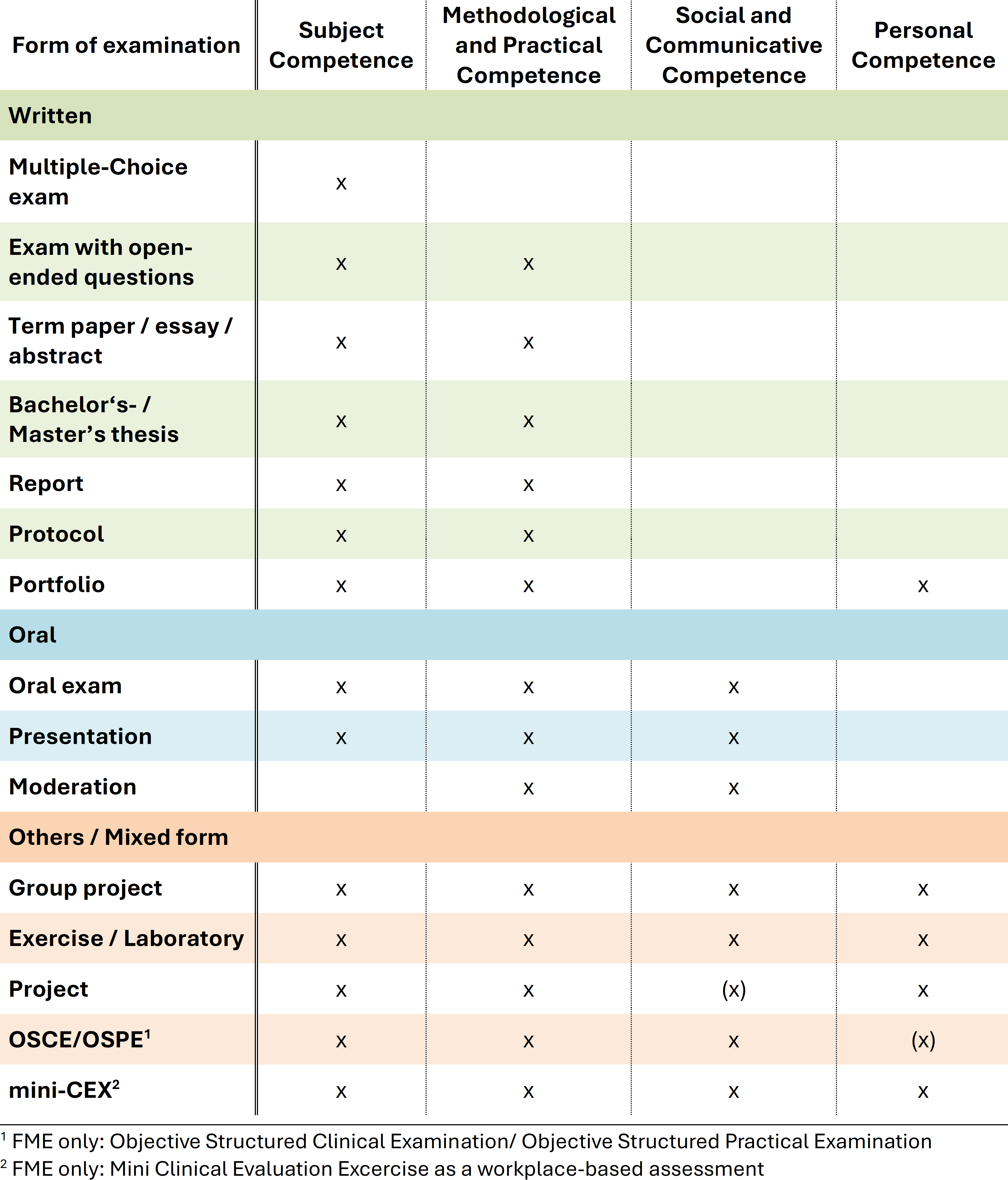
Examinations should generally be designed to assess the competencies (learning outcomes) acquired by students. This requires the competencies to be formulated in a way that makes them observable, measurable, and verifiable. Depending on the competency acquired by students, some examination formats are better suited than others, as shown in the figure below. For example, it is only rarely, and only in well-justified cases, possible to assess and verify social and communicative competencies in a written examination.

This list of possible examination formats according to the competencies imparted can also be found in the appendix to the Constructive Alignments guide. An overview of different examination formats and suggestions for designing examinations can be found inHTW Berlin's examination finder.

How do I create the Diploma Supplement?

The Diploma Supplement is a supplementary document issued with the transcript upon successful completion of a student's studies. It is issued at least in English. The Diploma Supplement is based on the European concept of providing standardized information describing higher education qualifications. It is intended to facilitate and improve the assessment and classification of academic qualifications both internationally and nationally, for study-related as well as professional purposes.

When do I need an internship policy? / How do I create one?

If an internship is included in the study program curriculum—that is, if students are required to complete a compulsory internship—internship regulations are mandatory. These internship regulations must be prepared in addition to the Study and Examination Regulations and must likewise be adopted through the university's committee process. Important elements of the internship regulations include:

  • the objectives of the internship,
  • form and duration of the internship,
  • admission requirements for the internship,
  • content of the internship,
  • implementation of the internship,
  • recognition of the internship,
  • if applicable, an internship report or similar evidence,
  • if applicable, information on the internship agreement and insurance coverage

Last Modification: 12.08.2026 -
Contact Person: